Supporter
Spotlight

Sarah Mehra

The first time I met Sarah Mehra, we sat and talked on her couch while her two dogs, Willow and Dolly, took turns “asking” me for attention. My kind of visit! Sarah was a corporate lawyer seeking a more meaningful career path, which I admire so much. It also resonated with me, as I myself left the corporate world many years back to work full time at Mercy For Animals. A dedicated animal lover, Sarah began fostering puppies a few years ago, and her home is now well equipped to take in several at a time. She has also become a teacher and is an adjunct professor at Villanova University. Sarah has been a proud supporter of Mercy For Animals since 2022, although we first met in person a little under a year ago. Today, I keep her updated on all the great things she makes happen for animals through the Compassion Collective, and she keeps me updated about how the latest batch of puppies ended up with her, the latest trouble they are causing, and the new foster protocols she is helping implement. Enjoy getting to know her a little better.

Q – Tell us about yourself and how you became interested in animal protection.

A – I am a quasi-retired attorney. I live with my husband outside Philadelphia and have two kids, one in college and one who just graduated. I never had any animals in my life, no childhood pets or even really friends with pets, until COVID. My kids had been asking for years for a pet, but I knew as the mom, the buck would stop with me as far as care and feeding. By the time COVID came around, my kids were old enough, I felt that was a task I could handle, and we all needed something positive to focus on. We adopted a senior dog. My thinking was that we’d give her some good golden years, the kids would move out, and when she crossed the rainbow bridge, our animal chapter would be done. Ha—that plan did not work out! We all fell hard for that dog, but especially me. Having such a strong and rewarding relationship with her opened my eyes to the fact that while animals might not share our humanity, they are individuals with spirits, feelings, and dignity, and people owe them care and protection. So, down the rabbit hole I went. 

Q – What does being in the Compassion Collective mean to you?

A – The opportunity to be part of an organization that is able to move the needle and really have an impact on improving the treatment of animals. Also, the information I receive has really changed my life, from what I eat to my approach to consumerism in general.

Q – What part of Mercy For Animals’ work is closest to your heart?

A – As a lawyer, I have to admire the work you do on the legislative front. I also think the undercover investigations you do are invaluable—I think that for so many folks there is a real lack of information connecting what is on their plates and the horrors of factory farming. Getting that out there helps us all become more compassionate about our food choices, helps the animals, and helps the workers stuck in the dehumanizing factory-farming system.

Q – I’m not going to lie. One of my favorite parts about knowing you is that you always send me pictures and videos of the puppies you foster. Tell us about how you got involved in that. Any fun stories to share?

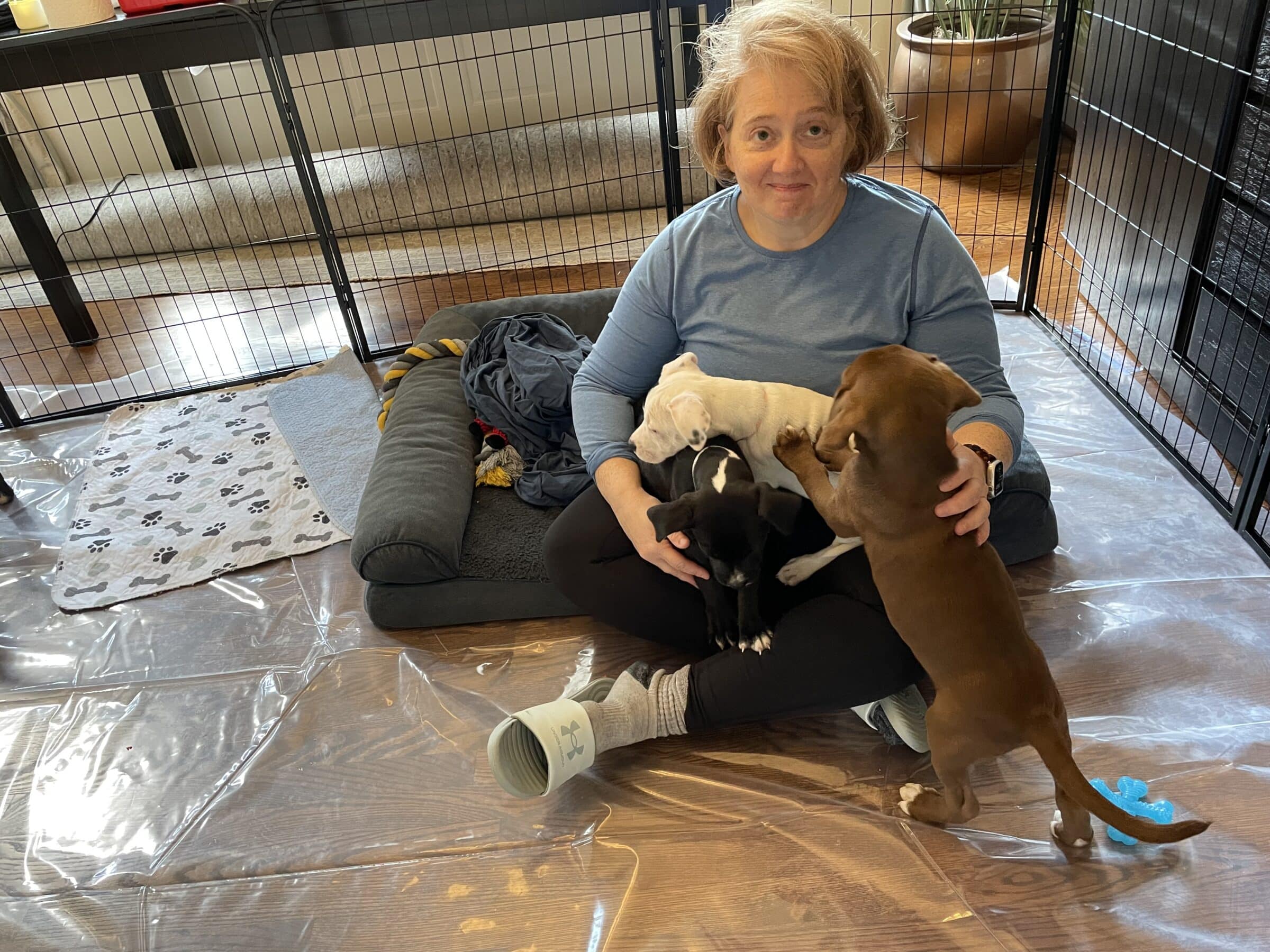
A – Another way that my plan to have a one-and-done experience with our first dog was scuttled was that she passed away much sooner than expected. We had only 16 months with her. After she died, I realized I never wanted to live in a dogless house, and so we adopted more dogs. I appreciated that we got to meet all our wonderful dogs because of the efforts of dedicated fosters, and I wanted to pay it forward. I was not an experienced dog owner, so I wasn’t sure I was up to the job of fostering an adult dog or that my current dogs would be a good fit for that. Luckily, the rescue we work with has a “puppy team,” and we can foster litters of puppies. We generally take three or four at a time (although we’ve had as many as five—that was exciting!), and they are adopted relatively quickly, typically after a few weeks. So while our big dogs aren’t always thrilled with the pipsqueaks, they’ve come to tolerate it, knowing that it’s temporary. As you know, puppies are just little joy machines. 

I don’t know that I have any particularly funny stories other than generic ones about how insanely destructive and gross puppies are, which are funny to me because I have the sense of humor of a 12-year-old. Now we turn our dining room into a corralled puppy pen, but before that, I would just fence off the kitchen area and let them run free, and they just ate the kitchen cabinets! They ate my dining-room breakfront and door too, but I’ve fixed those and have a workaround to prevent that going forward. They are devious little stinkers, and I say that with love. My take is that you can have either nice stuff or dogs, but you have to pick one, and those dogs won. A five-dog litter that was an absolute chaos army became very quiet, so I went and checked on them and saw that they had gotten into the garbage and were eating scraps of tin foil with food on it—they had shiny poo for a couple of days. The second time I fostered, I didn’t know to bring a crate, and I didn’t know that most puppies get off transport and then spend their first 20 minutes off the bus pooping nonstop. My daughter was with me, and we’re driving these two little puppies home. They are just rioting around the back of my car, pooping it up, and she is gagging and hanging her head out the window on the highway. (My superpower is that I’m basically immune to puppy poop, thank goodness.) Our very first foster puppy was an absolute angel but just wanted to chew on Willow’s ears, so every time I saw him go for that, I stuck my arm in his mouth instead, which I said was like getting the world’s worst acupuncture for a week. He was also given to us housebroken, but he came into our house and literally had diarrhea in three rooms in the first 15 minutes. See, gross and destructive, so not really humorous for a broad audience. I’m sorry!

Q – What is the most important thing activists can do?

A – Get out there and do something, whatever it is. Facing the need can be hard and overwhelming. From my fostering, I know there is an endless stream of dogs of all ages, and not every one is going to get saved. And I know Mercy For Animals has their work cut out for them—so many people are suffering in various ways that it can be a natural reaction not to prioritize animals, and corporations work hard to ensure that we stay ignorant of their cruel practices. I think the key is not to let that turn into helplessness or paralysis and just to take real action, big or small. No matter how many puppies I foster, it’s going to be a drop in the bucket, but each one is a meaningful life, and that means something. I know Mercy For Animals doesn’t have a magic wand to completely change the global food system, but I support the organization because I also know you never stop working for positive change and are able to achieve goals on a broad scale that are important to me, and I do have faith that one day Mercy For Animals will play a big part in getting us there.